I'm Bismark, a mixed-methods educational researcher, and the founder of civic-technology platforms that make education and governance more transparent in Ghana.
How generative AI tools reshape academic research, writing, and student support in higher education.
Qualitative, quantitative, and mixed designs — from phenomenology to IRT and Monte Carlo simulation.
Building platforms that put accountability and transparency data directly in citizens' hands.
The experiences of African and international students — advising, retention, and sense of belonging.

I began as a teacher and head teacher in Ghana, where I led curriculum design, mentored students, and, through Lead for Ghana, secured a grant for 37 laptops and a library renovation at a rural basic school (Kedzi). That work convinced me that education and good information change lives.
Today I'm a doctoral candidate in Educational Research & Evaluation at Ohio University, where my research interest includes investigating the role of AI in enhancing academic research and student support. I served as Assistant Managing Editor of the Journal of Student Affairs Research and Practice (Taylor & Francis) and advise 100+ exploratory students at University College.
Alongside research, I build civic technology, turning the same evidence-first mindset into tools people can actually use.
Three things I've built where data meets the public, an interactive research dashboard and two civic-technology platforms for Ghana.
An interactive dashboard that brings my research data to life — letting reviewers and collaborators explore analyses and visualizations directly in the browser.
A civic-engagement platform connecting citizens with government — issue reporting, transparency dashboards, and MP-accountability scoring to close Ghana's governance information gap.
A public report card for every Ghanaian school — parents rate teaching, safety, and fees; schools that ignore complaints drop on a transparent accountability scoreboard.
I work across the quantitative–qualitative divide. Below are illustrative visualizations in the style of my studies.
Faculty vs. students across four dimensions
African international students, by dimension
Sentiment analysis of citizen feedback (Ghana)
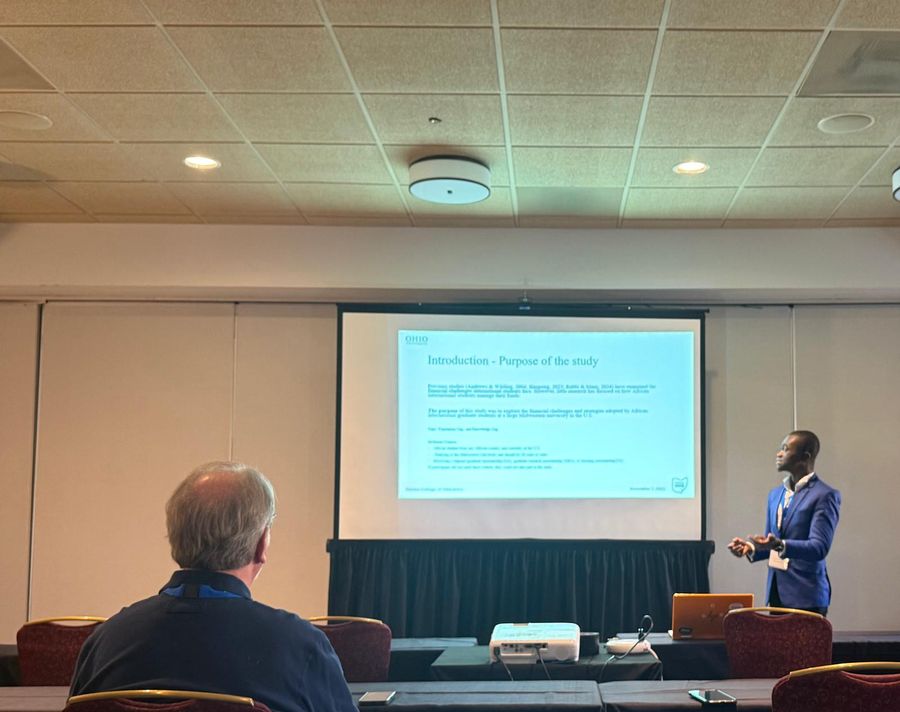
Articles, blogs & conference presentations
Themes by coded reference frequency
How a digital experience is felt, not just observed
My phenomenological work treats lived, embodied experience as data, pairing what participants say with what they feel to surface meaning that surveys miss.
The screen was right there, but I felt a thousand miles from anyone who understood me.— illustrative participant voice, belonging study
When the AI explained it, I could finally breathe and write.— illustrative participant voice, AI-support study

Whether it's mixed-methods research, AI in education, or building tools that serve the public — I'd love to hear from you.
bb274819@ohio.edu